Sound Effects Models Ranked (2026): Prices, Tests and What We Use
Sound effects are where a drawn film earns its weight: the bell that lands with the hammer, the rain that makes the drawn window feel cold. This ranks every sound-effects model we can actually run through ElevenLabs and fal, ordered by our own short-cue tests and published prices, with the clips and spectrograms we generated on 17 October 2026 so you can judge them yourself.
By Syver-August, Developer, North Noir · · 7 min read
Why sound effects matter in an AI-drawn video
In AI-drawn video every frame is drawn by the model in code, and none of the sound is baked into those frames. A cue is a separate lane you can mute, swap or re-time — which also means the cue has to earn its place. A drawn character who stops mid-step is a drawing; the same drawing with a door slam behind it is a scene.
That makes the choice of sound model a craft decision, not plumbing. The three things that matter for a short cue are timing (does the one-shot land and decay inside the seconds you have), structure (one isolated slam or five when the script says one) and price (a cue is cheap to want and easy to want a hundred of). This article ranks the routes on exactly those terms.
What we ranked, and how
We ran every text-to-sound-effects route we can provide — ElevenLabs Sound Generation direct and the same model via fal, plus the fal routes Sonilo v1.1, MMAudio V2, CassetteAI, Mirelo SFX2.0, the Stable Audio family and the LTX 2.3 audio branch. There is no published sound-effects benchmark to lean on: Artificial Analysis ranks music, not cues. So the order below is our short-cue utility composite — 80% from our own visual/metric review of the generated files, 20% from published price — and the verdict column says why each model sits where it does.
Our test is small and honest about it: three cues, one four-second run each — “small harbor bell”, “a wooden door slamming shut”, “steady rain on a tin roof” — decoded, measured and reviewed as spectrograms. We did not run a listening test, we cannot tell you which one sounds better, and a spectrogram is not a realism score. The clips are published in full so you can audition them yourself.
Sound effects models, ranked
Prices are the providers’ published rates; where a page quotes a per-second rate we say so, and where no usable all-in price was published we say unresolved rather than invent one. Reliability was 3/3 delivered for every route in the table.
| Rank | Model | Runs on | Price | Our test verdict |
|---|---|---|---|---|
| 1 | Sonilo v1.1 SFX | fal | $0.0018/second | Best composite (91.1): all three cues at 3.99s vs 4s, one clear attack on the door cue |
| 2 | MMAudio V2 | fal | $0.001/second | Cheapest per second (89.2): all cues at 4.02s; our door cue had extra events around the main slam |
| 3 | ElevenLabs Sound Effects v2 | ElevenLabs direct + fal | $0.12/minute direct (fal lists $0.002/second) | Exactly 4.00s on all three (87.1); smooth bell decay — the route North Noir uses for cues |
| 4 | CassetteAI Sound Effects | fal | $0.01/generation | Flat per-cue price (82.5); 4.00s exactly, decoded peak reached full scale on two cues |
| 5 | LTX 2.3 audio branch | fal | Unresolved — the page quotes a video tariff | 4.05s cues (82.0); price carries a neutral score because no audio rate converts honestly |
| 6 | Mirelo SFX2.0 | fal | $0.010/second/sample promotion until 13 Dec 2026 ($0.015 standard) | Highest technical score (97.0) after we fixed our own duration field; the promotion is what keeps it mid-table |
| 7 | Stable Audio Open | fal | Unresolved — compute-based page, no all-in rate published | 4.00s cues (79.1); do not read the zero base price as free |
| 8 | Stable Audio 3 Small SFX | fal | $0.0206/generation | 4.00s cues (78.8); our rain cue was conspicuously pulsed rather than a steady bed |
| 9 | Stable Audio 3 Medium | fal | $0.0376/generation | 4.00s cues (78.1); the rain texture ended before the cue did in our run |
| 10 | Stable Audio 3 Medium Base | fal | $0.0479/generation | 4.00s cues (76.0); several separated events where the door prompt asked for one slam |
| 11 | Stable Audio 2.5 | fal | $0.20/generation | 4.00s cues (74.0); highest published cost per cue of the priced set |
| 12 | Stable Audio 3 Small SFX Base | fal | $0.0283/generation | Weakest composite (59.1): peaks above full scale and pulsed blocks on all three cues |
Our test clips, with spectrograms
Each clip below is the exact file the provider returned, untrimmed. The caption names the prompt used. Our verdicts come from decoding the audio, measuring timing, peak and level, and reviewing the spectrogram — a visual/metric review, not a listening session.
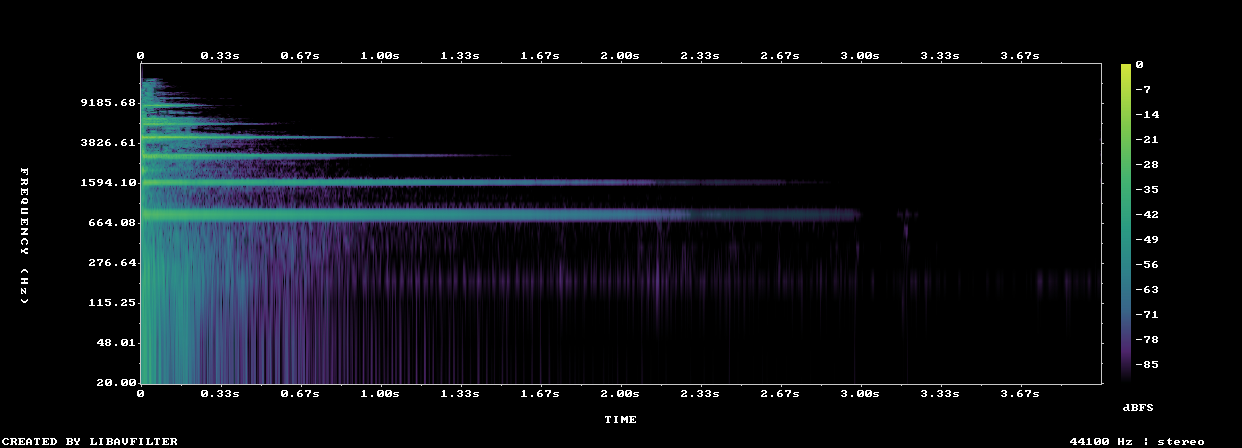
Prompt: “small harbor bell”. 3.99s delivered against a 4s target; several early strikes then ringing partials decaying to near silence.
Prompt: “a wooden door slamming shut”. 4.00s exactly; several closely spaced broadband attacks around 0.3–1.4s, then a decaying low-frequency tail.
Prompt: “steady rain on a tin roof”. 4.02s of stable broadband ambience with no long gap — the cheapest route in the table at $0.001/second.
What we left out
Video-conditioned routes (PixVerse, ThinkSound, Hunyuan, Foley and the video side of MMAudio) score sound against a picture and are not comparable to a text prompt like ours, so they are excluded rather than ranked. Speech synthesis, audio separation and inpainting routes are different jobs again, and the YuE entry in the catalog had no usable inference contract when we checked. None of these appear in the table.
How North Noir picks sound effects
Sound effects on a drawn section are a toggle, and they are off by default. Turn them on for a Ruvil 2.1 section (drawn in code by AI) or a Ruvil 7.3 section (images as frames), and you choose the source: sound_source: "ai" codes the cues alongside the drawings in the same program, while sound_source: "elevenlabs" generates them as ElevenLabs cues and muxes them under the section at stitch. The frames themselves never change — the cue rides its own lane on the editable timeline.
The same routes are exposed outside the Studio: POST /v1/audio/sfx generates cues from text, and the pricing page shows what a run costs in tokens. On the free plan the model runs on your own API key; ElevenLabs and fal keys are the two that feed the sound paths.
Fast and cheap cues
- Sonilo v1.1 at $0.0018/second — our top composite
- MMAudio V2 at $0.001/second when the budget is per cue
- Good for ambience beds and busy cue sheets
The cue North Noir ships with
- ElevenLabs Sound Effects v2: exact 4.00s cues in every test
- Direct at $0.12/minute, or the same model via fal at $0.002/second
- It is the
elevenlabssource behind the sound-effects toggle
For the music half of a film’s sound — beds and vocal tracks — read the companion piece, Background Music Models Ranked.
Key takeaways
- There is no published sound-effects benchmark, so the ranking is our short-cue utility composite (our visual/metric review + published price), not a listening result.
- Sonilo v1.1 ($0.0018/second) topped the composite; MMAudio V2 ($0.001/second) is the cheapest; ElevenLabs Sound Effects v2 delivered exactly 4.00s cues and powers North Noir’s sound-effects toggle.
- Prices were checked 17 October 2026 and span $0.001/second to $0.20/generation; two routes publish no usable all-in price and are marked unresolved.
- In North Noir, sound effects on Ruvil 2.1 and Ruvil 7.3 sections are off by default and sourced either from the drawing code (ai) or from ElevenLabs cues.
Frequently asked questions
Which sound-effects model is best for an AI-drawn video?
It depends on what you are optimising for, and there is no published sound-effects benchmark to settle it. In our short-cue utility composite Sonilo v1.1 came first and MMAudio V2 second, both on price; ElevenLabs Sound Effects v2 delivered the most exact timings and is the route behind North Noir’s sound-effects toggle.
How much do AI sound effects cost?
Published rates we checked on 17 October 2026 run from $0.001/second (MMAudio V2) and $0.0018/second (Sonilo v1.1) to $0.12/minute for ElevenLabs Sound Effects v2 direct, with several routes charging per generation ($0.01 to $0.20). Two routes publish no usable all-in price.
Is there a benchmark for AI sound effects?
No published one exists — the Artificial Analysis leaderboards rank music models, not cues. Our ranking therefore combines our own visual/metric review of three four-second cues with published price, and the raw clips and spectrograms are published so you can judge the sound yourself.
Can North Noir add sound effects to a drawn video?
Yes. Sound effects on Ruvil 2.1 (drawn in code) and Ruvil 7.3 (images as frames) sections are a toggle, off by default. The cues are either coded alongside the drawings or generated as ElevenLabs cues, and they sit on their own lane so you can mute, swap or re-time them without touching the frames.
How do I generate sound effects through the API?
POST /v1/audio/sfx takes a text prompt and returns a cue. The pricing page shows the token cost of a run; on the free plan the sound provider runs on your own API key, and ElevenLabs or fal keys cover the routes in this article.
Keep reading
- Background Music Models Ranked (2026): Vocals, Instrumental and Prices
- AI-Drawn Video, Explained
- Why We Draw Every Frame: The Problem With Text-to-Video, Image-to-Video, and Reference-to-Video
- Software for AI-Drawn Video, and Video Made by Code (2026)
- An AI Video Generator With Your Own API Key (BYOK)
- Ruvil 2.1 Explained: AI-Drawn Video With a .js Drawing Engine
- Ruvil 7.3 Explained: Hand-Drawn Frame-by-Frame Animation With AI
- Ruvil 2.1 vs Ruvil 7.3: Which AI-Drawn Video Model Should You Use?
- One Sentence, Any AI Harness, Any Model: AI-Drawn Video With the North Noir CLI